What Went Wrong? |
|
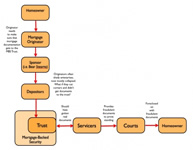
The Securitization Process |
|
 |
The Glass-Steagall Act, (the Banking Act of 1933), which had required the separation of banking operations between business types (commercial and investment banking) was repealed in 1999 by the Gramm-Leach-Blyley Act. Glass-Steagall had been enacted to manage risk after the breakdowns associated with the Great Depression. Glass-Steagall also created the Federal Deposit Insurance Corporation, which insured bank deposits and restored confidence in the soundness of the banking system. |
| Repeal of Glass-Steagall resulted in significant changes in the banking industry, particularly commercial banks. Their new willingness to incur new risk was not understood by consumers, who continued to perceive banks as conservative and risk averse, and therefore reliable. Accordingly, many consumers incurred debt in reliance on the fact that banks' willingness to make the loans was indicative of soundness and reasonableness of the loan terms, not realizing that the scene had changed drastically and that the lenders would not be holding the loans themselves so had no interest in their soundness.
The Federal Reserve lowered interest rates dramatically, apparently to keep the economy growing after the setbacks of the dot.com collapse and the 9-11 terrorist attacks. As a result, liquidity was abnormally large in 2002-2004. In 2004, the Fed began raising rates, triggering rate changes in adjustable rate mortgages which were tied to Fed. Funds rates. Excessive and inappropriate use of subprime products became widespread, aggravated by borrower misunderstanding of the risks involved, and compounded by sloppy lending practices. Subprime loans had been conceived for borrowers with lower quality credit. They had evolved as a mechanism for more Americans to own homes. Subprime loans were much easier for brokers and originators to get approved, bypassed normal underwriting standards, and entailed more profit than conventional loans due to higher interest rates and prepayment penalties. However, originators and brokers sold these loans to many borrowers who could have obtained conventional financing (source: Federal Reserve Bank of New York Staff Reports – "Understanding the Securitization of Subprime Mortgage Credit, p. 77) and oversold them inflated principal amounts, lending more money than borrowers could pay back". New "exotic" loans became available, such as interest only financing, adjustable rate mortgages, "piggyback" 80/20 loans, 120% loans. Inappropriate and inadequate underwriting at origination became the norm. In essence, they "threw away the rulebook". "Stated income" and "low doc" loans became commonplace, anyone could get a mortgage in virtually any amount. Virtually all of these loans were securitized. |
|
Securitization in Depth
Part 1 of 4